


A section with key insights from State of Pet Adoption Platform Insights 2025
Pet adoption trends on PetRescue.com.au
Understanding recent pet adoption trends provides important context for how pets in care are faring and how organisations are responding to changing conditions. Examining shifts in supply, demand and outcomes across the PetRescue community helps identify emerging challenges and opportunities to improve rehoming success.
69,703 pets were adopted via PetRescue in 2025, with another strong year of overall adoptions nationwide.
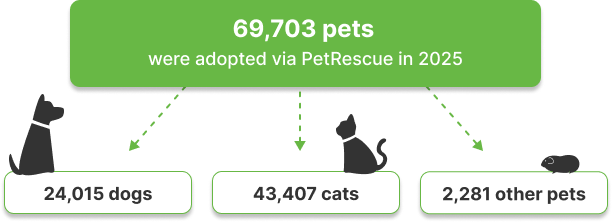
By species, this included:
- Cats: 43,407 (almost 3,000 more than 2024)
- Dogs: 24,015 (approximately 1,000 fewer than 2024)
- Other pets: 2,281 (approximately 160 fewer than 2024)
Falling adoption rates: the most important trend of 2025

Ninja adopted after 933 days
While not immediately evident in the whole of year adoption totals which have risen slightly since 2024, the most marked trend for pet adoption in 2025 was the falling adoption rates for all species (that is, the number of pets adopted within each month as a function of listings).
While 'Other pet' adoptions had begun dropping by the end of 2024, both dog and cat adoption remained steady until early to mid-2025.
Adoption rates fell from historical levels in the low to mid-90% range, to 54.4% for dogs and 62.6% for cats by the end of December 2025.
Based on the current trajectory of adoption rate decline, 2026 is expected to show significant deviations from historical adoption patterns with concerns around the fate of at-risk pets with no support network due to the system functioning beyond capacity, and the 'slower to move' pets already within the system.
While the overall trend for both dogs and cats is similar, the underlying data suggests that the cause of the falling rates is different for dogs and cats.
National monthly cat listings and adoptions on PetRescue.com.au (2021-2025)
Diego is still looking for love
While cat adoptions have slightly increased, the number of cats being made available for adoption has continued to increase substantially and supply is increasingly outpacing demand. This is particularly notable in Victoria where cat listings continue to increase year on year in the face of a strong adoption market, as reported in previous State of Pet Adoption reports.

For cats, it is clear that alternative options for addressing cat population management are needed, that do not involve intaking large numbers of cats into an already over-burdened system where they cannot realistically be offered a live outcome. PetRescue strongly advocates for evidence-driven, proactive management of community cats by local coalitions of government and not-for-profit organisations working together to deliver micro-targeted desexing cat programs.
National monthly dog listings and adoptions on PetRescue.com.au (2021-2025)

Duke is looking for love
To the contrary, dog listings have remained somewhat steady since mid-2024, while dog adoptions have dropped since mid-2025 despite the share of households with pets increasing from 69% in 2022 to 73% in 2025. Pet dogs are increasingly being purchased from breeders and pet shops (increased market share by 8% over recent years) rather than adopted from the rescue and sheltering sector. As such, it appears that weakening adoption demand is driving falling dog adoption rates.
Concerningly, falling adoption rates for all species are occurring alongside falling median (cats -36%, dogs -24%) and average (cats -40%, dogs -42%) days to adoption. When combined, these trends indicate that while popular pets such as small breed puppies were adopted as fast or faster in 2025 than previously, pets from high-risk cohorts that previously took longer to find homes are increasingly being removed from the platform without adoption. That is, less popular pets are no longer being held in care for extended periods to secure adoptive placement, and are instead being removed from adoption for transfer to other organisations, or potentially, being euthanased due to care capacity or deterioration in their health or behaviour following long-term sheltering.
Less popular pets are no longer being held in care for extended periods to secure adoptive placement, and are instead being removed from adoption for transfer to other organisations, or potentially being euthanased due to care capacity or deterioration in their health or behaviour.
In 2025, with increasing cost of living and housing pressures sustaining high intake into the system, and decreasing adoption rates and donations to support life-saving work leading to reduced life-saving capacity, we expect that previously reported negative impacts of system-level challenges on individual wellbeing will be greater than previous years. Unless this trend reverses throughout 2026, these factors together have the potential to lead to shrinking of life-saving capacity through rescue and increased preventable euthanasia of pets.
What is driving falling dog adoption rates?
Focusing on dog adoptions in particular, reduced interest in adopting rescue pets appears most pronounced in adults aged 18 to 47 years. As Millennials and Gen Z are noted as the generations with the greatest interest in ethical consumerism and increased familiarity with online marketplaces, the shift away from online rescue pet adoption appears contradictory. This is particularly interesting given that a smaller proportion of adopters aged 18 to 47 report obtaining their pet specifically to help a rescue pet, compared with adopters aged 48 years and over. Together, these findings suggest that motivations for pet acquisition may differ across age groups and could be contributing to changing patterns in rescue pet adoption.
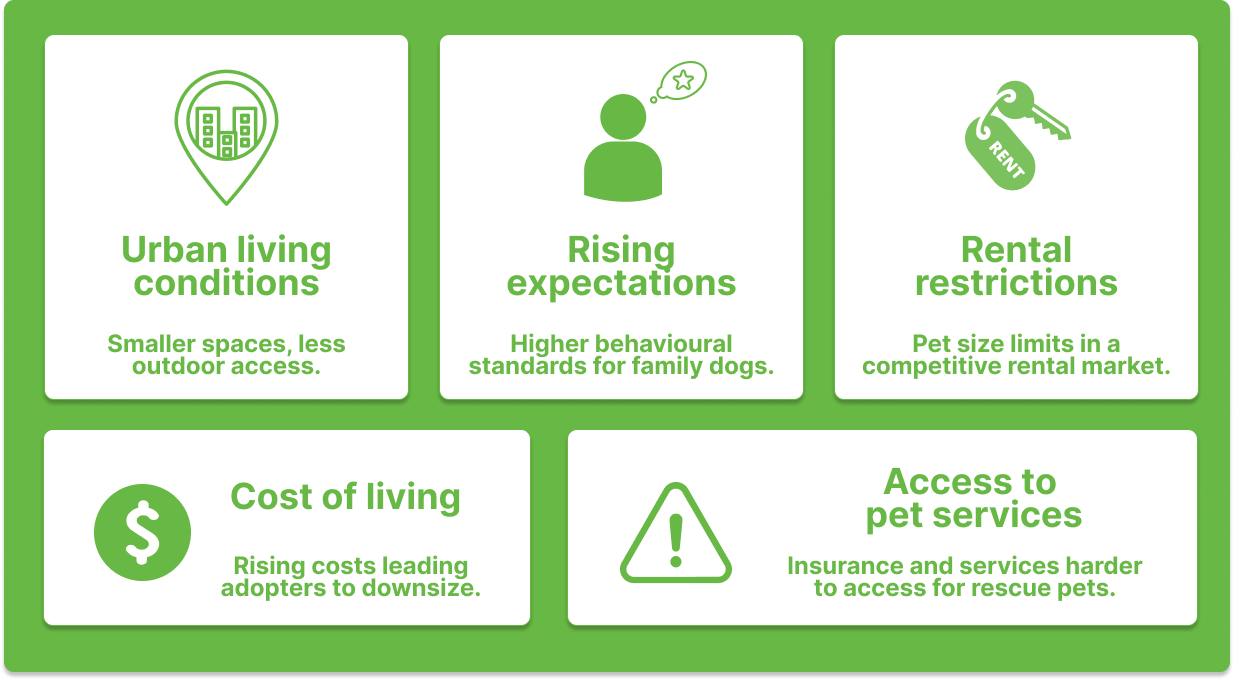
Urban living conditions: Smaller spaces, less outdoor access. Increasingly restricted, intensive living conditions for people living in metropolitan areas wanting to add a dog into their family (e.g. small or no yard, reduced access to public open space or off-lead areas, increased exposure to environmental stressors).
Rising expectations : Higher behavioural standards for family dogs. Increasing recognition of dogs as family members and integration into family activities outside the home, leading to higher expectations of behaviour.
Rental restrictions: Pet size limits in a competitive rental market. Rental restrictions on pet size or type, or the perception of it being harder to secure a rental because of dog ownership.
Cost of living: Rising costs leading adopters to downsize. Increased cost of pet care exacerbating cost of living pressures, leading people to choose a smaller or lower-maintenance dog.
Access to pet services: Insurance and services harder to access for rescue pets. Issues accessing pet services such as insurance for rescue pets and dogs that are obtained after puppyhood (Pet Insurance In Australia: Should You? Shouldn't You?).
This shift is supported by the findings of the AMA 2025 pet ownership survey and report, which found that so-called 'designer dogs' were more likely than other newly acquired dogs to have been:
✂️ Chosen for their low-shedding or hypoallergenic qualities (19% vs 7% non-designer breeds)
👧 Picked to teach responsibility to children (11% vs 7%)
💼 More likely to be taken to work (13% vs 7%)
✈️ More likely to be taken on flights (7% vs 3%)
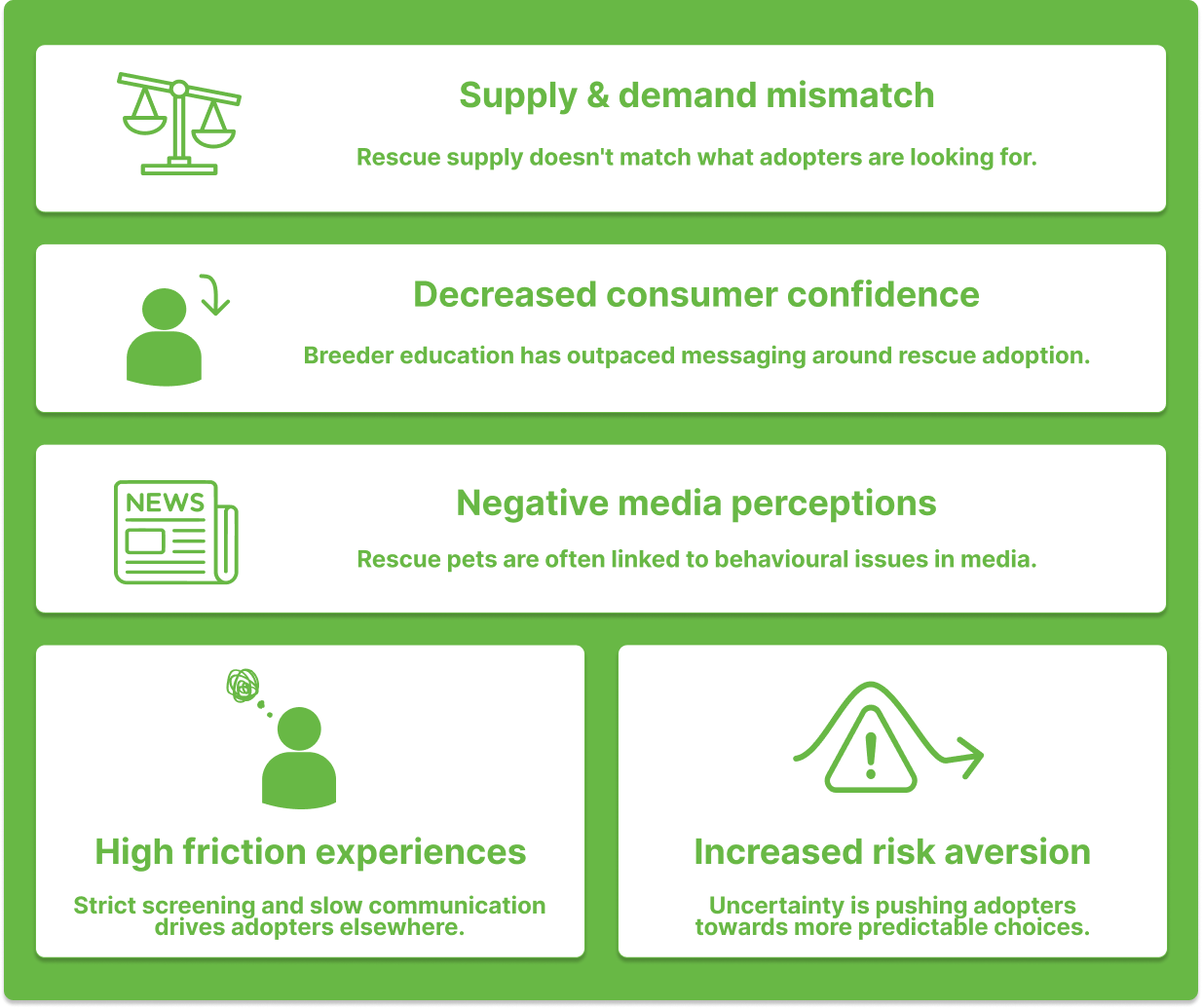
A supply and demand mismatch for available pets, especially for dogs in metropolitan areas, as medium and large mixed-breed dogs of working or bull-breed types dominate the supply of available rescue dogs.
Decreased consumer confidence in the rescue and sheltering sector as a trusted source of pet dogs that suit the needs of adopters. Following increased recognition of the role of online pet marketing in the rise of intensively bred 'puppy farm' dog sales, Australians have been hearing about how to choose a reputable breeder for more than a decade from a variety of sources such as the RSPCA, pedigree dog associations, and even pet insurance companies.
This increases consumer knowledge of breeders as a source of dogs and confidence in their own ability to navigate puppy buying ethically. Education and behaviour change initiatives related to selection of adoption pets and pet rescue organisations has not received the same attention as for breeders, despite the sector being wholly or largely unregulated across Australia.
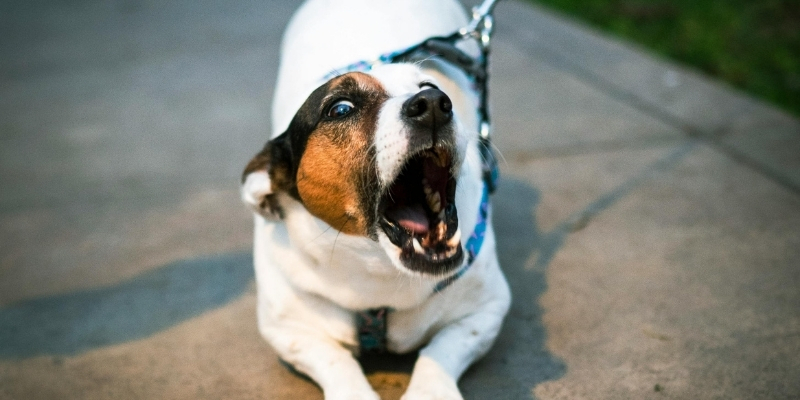
Negative media perceptions around rescue pets. Both social and traditional media have commonly linked dog aggression, behavioural problems and attacks to rescue pets, or types of dogs that are commonly found within the sheltering and rescue system, creating a perception that rescue dogs are less behaviourally predictable than puppies that people raise themselves. This increases the perception of risk related to rescue dog adoption, while failing to provide potential adopters with the knowledge to make informed, ethical choices, resulting in poor consumer confidence in rescue dogs as a source of their next pet.
Increased risk aversion more generally due to economic, housing, and world stability, leading potential adopters to become more risk sensitive, therefore more likely to make choices that they feel more certain about (like buying a purpose-bred puppy of their desired breed from a breeder they consider ethical).
In the face of these factors, potential adopters become less tolerant of so-called 'high friction' adoption experiences, such as strict pre-adoption (or pre-meet) screening processes, slow or poor communication with rescue organisations, and barriers to adoption that they perceive as unfair or unnecessary, leading them to choose other avenues for adding a pet dog to their family.
In practical terms, demand for family pet dogs is shifting towards predictability, convenience and lower perceived risk, and away from uncertainty, friction and the constrained choices perceived as inherent to rescue pet adoption.
Demand for family pet dogs is shifting towards predictability, convenience and lower perceived risk, and away from uncertainty, friction and the constrained choices perceived as inherent to rescue pet adoption.
For the sector, a trend towards decreased adoptions, potentially leading to higher levels of humane killing for capacity management is particularly concerning. This follows consecutive years of heightened work-related stress across the sector and declining financial sustainability of rescue programs reliant on adoption fees and donations. This increases the risk of both burnout and compassion fatigue in a sector that already experiences unacceptably high levels of both.

Jump to specific insights from the report:
Images: Canva, unless captioned otherwise.