


A section with key insights from State of Pet Adoption Platform Insights 2025
PetRescue member organisations
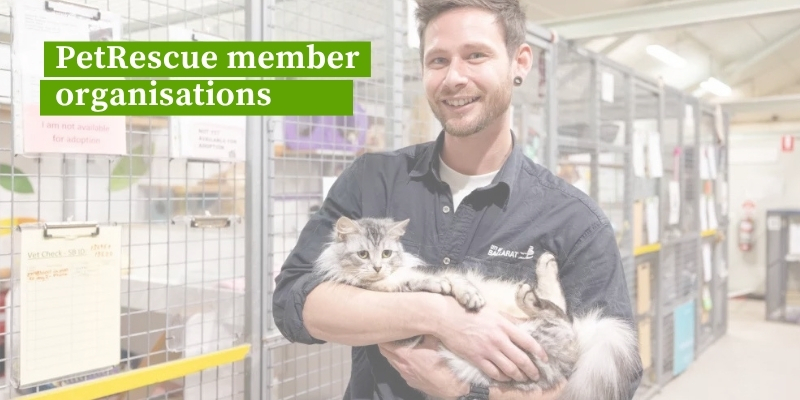
Image: Ballarat Animal Shelter
PetRescue's member organisations form Australia's largest and longest-standing reputable rescue and companion animal welfare community dedicated to the ethical rehoming of pets, and are trusted by adopters nationwide.
All members meet PetRescue's Membership Code and Pet Listing Rules, providing a clear and consistent standard that helps adopters assess organisations with confidence. Group type plays an important role in how organisations operate, including the pets they care for and their connection to local communities, so understanding the diversity of members enables PetRescue to better support them and advocate effectively for the sector at both local and state levels.
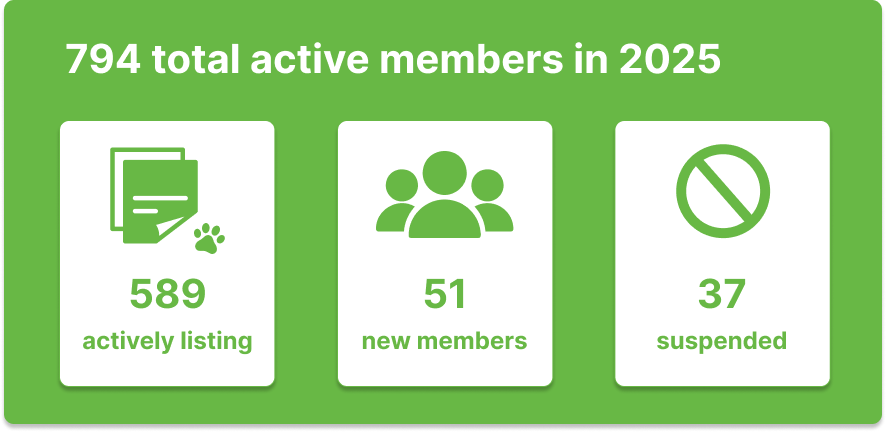
589 member organisations actively listed pets during the 2025 calendar year (of 794 or so total members with an active status during this period). A greater proportion of each member cohort, except vet clinics, were actively listing pets in 2025 compared to 2024, with 85% of rescue members and 82% of shelter members actively listing pets. This is likely related directly to increased capacity strain and falling adoption rates, with member organisations using multiple avenues to reach potential adopters.
The PetRescue community welcomed 51 new member organisations in 2025, while 37 organisations were suspended throughout 2025.
Reasons for member suspension include:
❌ No longer able to meet requirements for PetRescue member organisations
❌ Breaches of the PetRescue Membership Code that could not be resolved
❌ The organisation closed down
❌ Inactive on the platform for a prolonged period and automatically removed
Active members by organisation in 2025
Image: Mornington Peninsula Community Animal Shelter
As part of PetRescue's ongoing work to support and highlight the high standard set by the rescue community, throughout 2025 a review was undertaken of all member organisations to ensure they could meet current minimum standards for members.
This involved verifying organisation ABNs and personal references from their veterinary service provider.
353 PetRescue member organisations are registered charities with the Australian Charities and Not-for-profits Commission (ACNC), making up approximately half of the current membership.
🏛️ 19 large charities, all but one of which are large companion animal shelters
🏢 23 medium charities that are a mix of smaller shelters and large rescue organisations
🏠 311 small charities, almost exclusively made up of volunteer-run rescue organisations
ACNC registered member organisations are able to fundraise directly through the PetRescue platform through the partnership with ANZ's 'Shout For Good' program. 87 of PetRescue member organisations use this function, together raising $152,609 in 2025 to directly support their vital work.
Listings and adoption outcomes by PetRescue member organisation type
Volunteer-run rescue groups listed the highest number of available pets in 2025 (35,505), representing 48% of adoptions facilitated via PetRescue.com.au. In comparison, volunteer-run rescues in the USA account for approximately 15% of intakes nationally, with the majority of intakes being transfers in from shelters.
This highlights the unique reliance of the Australian animal management and sheltering system on a large, informal network of volunteer-run rescue organisations to ensure live outcomes for almost half of pets adopted into new homes each year.
Shelters recorded 28,314 adoptions in calendar year 2025, compared with 32,971 for rescue groups. Shelters rehomed pets fastest, with a median time to adoption (TTA) of 3.2 days for pets listed and adopted in 2025, and a 90.5% same-year adoption rate for pets listed in 2025. Shelters generated these outcomes from substantially fewer enquiries on 2025 listings: 13,457 compared with 70,150 for rescue groups.
*However, caution is required in interpreting these findings as many shelters have public access for walk-in pet adoption, meaning that a cohort of shelter pets listed on PetRescue.com.au find their homes through in-person meetings not reflected in enquiry statistics.
Rescue groups generate the bulk of enquiries (69,799, 76% of total) but have the longest median TTA of 21.0 days, and the highest enquiry to adoption conversion rate of 2.6 enquiries for each pet marked adopted. Generally, a high enquiry volume relative to adoptions and long median TTA reflects a less streamlined, more barrier-driven adoption process focusing on strict screening of adopters.
As discussed in the 2024 State of Pet Adoption report, international research shows that pre-adoption screening results in fewer adoptions without commensurate reductions in post-adoption problems compared to inclusive, conversational adoption processes combined with effective post-adoption support.
Councils sit in between shelters and rescues with a median TTA of 9.0 days, an 88.2% adoption rate and relatively balanced enquiry-to-adoption ratios.
In 2025, vet clinic members adopted just 61% of the pets adopted in the 2022-2023 financial year, indicating a significant reduction in adoptions facilitated through clinics. This likely reflects the impact of ongoing pressures on the veterinary sector, including vet and nurse shortages and challenges to financial sustainability, and increasing corporate ownership of practices that may restrict the implementation of adoption programs on site.
Use of shelter management software APIs for listing pets on PetRescue.com.au
Member organisations can list pets on PetRescue manually, or connect their population management software directly via PetRescue's software integrations, allowing pet profiles to sync automatically. The proportion of members using manual entry for pet profiles has dropped by 5% since July 2024 for all organisation types other than vet clinics, with the greatest reduction occurring in shelters. While it is unclear whether these positive changes are reflective of increased access to population management software by member organisations, or simply greater uptake of the API function by organisations already using this software, this represents a welcome and significant saving in time and effort for member organisations.

Trends in the distribution of pet listings and adoptions in different organisation types
In 2025, we saw a continuation of the shift in pet listings, with both shelters and councils listing more pets than in previous years while rescue groups remained relatively steady.
This is consistent with previously reported constraints on capacity in volunteer-run and donation-funded rescues, driven by increasing costs of care, declining donation income and longer lengths of stay associated with changing adoption patterns.
At the same time, councils and shelters continued to play an increasingly important role in providing live outcome pathways for pets in care. Compared with 2024, shelters listed an additional 1,575 pets and councils listed an additional 1,007 pets, while rescue group listing volumes increased by just 129 pets.
Total adoptions also increased in 2025, rising from 67,248 to 69,582. Councils recorded 944 additional adoptions compared with 2024, while shelters and rescue groups recorded increases of 365 and 367 adoptions respectively.
Impact of adoption policy and approach on pet outcomes
In addition to practical factors that impact pet advertising, adoption policies and practices also impact pet adoption outcomes. Increasing attention has been paid to the impact of pre-adoption screening of adopters, adoption practices for pet matching and placement, and post-adoption support on pet outcomes, including long-term retention of adopted pets in the home. Briefly, organisations that have moved away from traditional policy-based screening processes, and follow best practice pet marketing, use inclusive, conversation-based pet matching, and proactively provide post-adoption support to new pet guardians, have the fastest and most successful adoption placements for pets in their care.
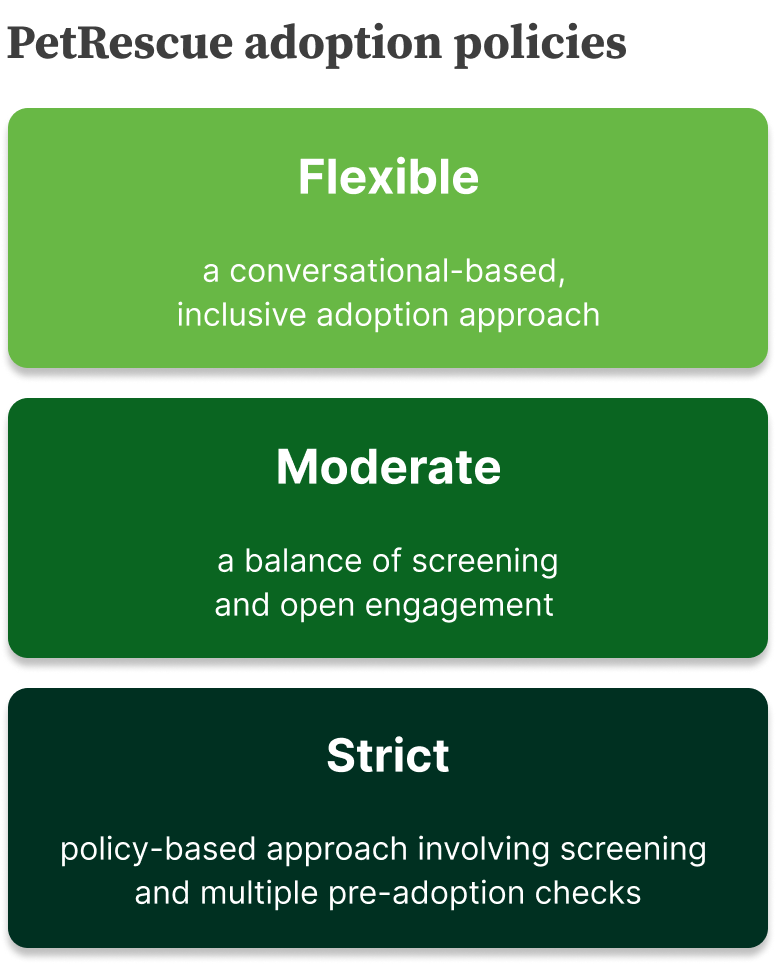
On PetRescue.com.au, member organisations are able to self-select an adoption policy that best reflects their matching practices. Adoption policy levels describe how in-depth an organisation's screening process is, helping adopters find an organisation that best suits their needs.
PetRescue members can choose from three policy descriptions:
- Flexible: a conversational-based, inclusive adoption approach
- Moderate: a balane of screening and open engagement
- Strict: policy-based approach involving screening and multiple pre-adoption checks
In 2025, moderate and unclassified groups accounted for 75% of all adoptions (25,199 and 27,137 respectively), while strict groups were responsible for just 6% of adoptions (4,200).
Adoption policy significantly impacts adoption speed, with median TTA roughly tripling from flexible (7.1 days) to strict (23.2 days). Consistent with previous years, unclassified groups behave similarly to flexible groups on TTA (median 8.0 days), suggesting many may effectively operate with flexible policies. These groups also adopt out the most pets per member annually (121 pets on average in 2025), while strict groups adopt out the fewest at 58 pets per member. The gap between median and mean TTA widened with increasing strictness of adoption policies, being largest in moderate and strict groups, with average TTA of 66-69 days.
In 2025, dogs take longer to rehome than cats across every policy level, consistent with the high proportion of kittens compared to puppies available for adoption. However, the gap narrows as strictness of adoption policy increases:
- Flexible policy:
- cats 6.8 days
- dogs 8.7 days (1.3x)
- Moderate policy:
- cats 16.9 days
- dogs 23.9 days (1.4x)
- Strict policy:
- cats 23.9 days
- dogs 24.7 days, virtually identical
The dramatic slowness of adoptions of both dogs and cats by strict groups suggests that strict adoption processes create a similar bottleneck for both species, whereas in more flexible environments cats naturally find homes faster than dogs.
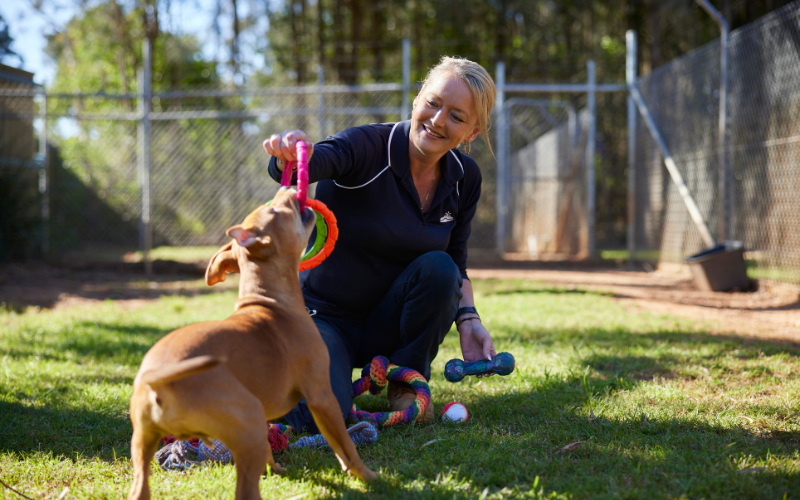
Image: Port Macquarie Animal Shelter
Interactions of adoption practices and policies on pet adoption outcomes
As noted in previous State of Pet Adoption Reports, member cohorts tend to trend towards certain adoption approaches, and this confounds findings about differences between adoption outcomes for pets in different types of organisations.

For dogs, the interaction between organisation type and policy level impacts adoption outcomes differently for different member cohorts:
🏢 Shelters achieve the fastest outcomes for dogs (median TTA of 3.2 days) with a high adoption rate, and no statistical difference between shelters based on their stated adoption policy
🏛️ Similarly, there is little difference between council member adoption outcomes for pets based on adoption policy
🏠 However, the spread within rescue groups is striking: flexible rescue groups rehome dogs in half the time of moderate ones (16 vs 31 days), and that difference is highly statistically significant. The moderate rescue group cohort has the highest standard deviation (59 days), indicating a very long tail of hard-to-place dogs.

For cats, the pattern observed in adoption outcomes by member cohort and adoption policy is different:
🏢 For shelters, median TTA spans from 2 days for flexible groups to 3.9 days for strict groups
🏛️ For councils, median TTA varies from 6.8 days for flexible groups to 10.8-11.8 days for moderate councils and those with no policy selected
🏠 Rescue groups are again the cohort with the slowest moving adoptions, and the policy effect within rescue groups is even more pronounced than for dogs. Strict rescue groups take 2.8x longer than flexible ones (36.9 vs 13.1 days) to find homes for their cats.
The consistent finding across both species is that flexible rescue groups significantly outperform all other rescue policy levels on TTA, while maintaining comparable or better adoption rates. Stricter policies correlate with higher variance, suggesting they create more outlier cases where pets remain available on the platform for extended periods.

Jump to specific insights from the report:
Images: Canva, unless captioned otherwise.