


A section with key insights from State of Pet Adoption Platform Insights 2026
15. Where do people turn when they need help?

What we already know
PetRescue's Finding Another Way Home report examined five years of Home2Home data. It found that most guardians seeking help were deeply committed to their pets, and were facing complex, overlapping challenges. The most common were moving house or unsuitable housing, not having enough time, behaviour challenges, a new baby, and financial hardship.
What happened this year

PetRescue's Tailored Pet Support and Home2Home services show us guardians who reach out for help before, alongside, or instead of relinquishing their pet to a shelter, rescue or council.
Tailored Pet Support
Tailored Pet Support helps guardians directly through advice or a referral to local pet support services. Completing a Tailored Pet Support request is also the first step for every Home2Home application, so a small number of requests go on to become Home2Home cases.
PetRescue received 8,239 Tailored Pet Support (TPS) requests between 1 July 2025 and 30 June 2026.
TPS cases involved 3,414 dogs, 3,103 cats and 239 other species of animal. 1,672 submissions did not record a species of pet in the support request.
TPS requests can be made directly by a guardian, or on behalf of a client, family member or friend. 1,169 guardians for whom help was sought were also supported by a case manager from a human support service.
Note: These figures add up to more than 100% because a single guardian’s case can involve more than one reason for seeking help.
The reasons guardians contacted Tailored Pet Support point to a different kind of need from those seen in rehoming requests.
The most common requests were for advice on temporary care options (1,087) and homelessness support (876), followed by family violence support (462) and help with food and living costs (446).
Smaller numbers sought training and behavioural support (338), veterinary care assistance (304), care for a pet during a hospital stay (267) and aged care support (60).
Many of these are short-term crises, where a guardian needs a safe place for their pet, or practical support, to get through a period of disruption, rather than a permanent new home.

Home2Home
Home2Home helps guardians rehome their own pet directly to a new home, without the animal needing to enter a shelter or rescue.
In 2025–26, PetRescue received 271 Home2Home applications, and 213 of these became open cases. Some guardians were looking for homes for more than one animal, such as a bonded pair or a litter, so these cases involved 314 pets.

Read about Goose who was adopted through PetRescue’s Home2Home program.
Note: These figures add up to more than 100% because a single guardian’s case can involve more than one reason for seeking help.
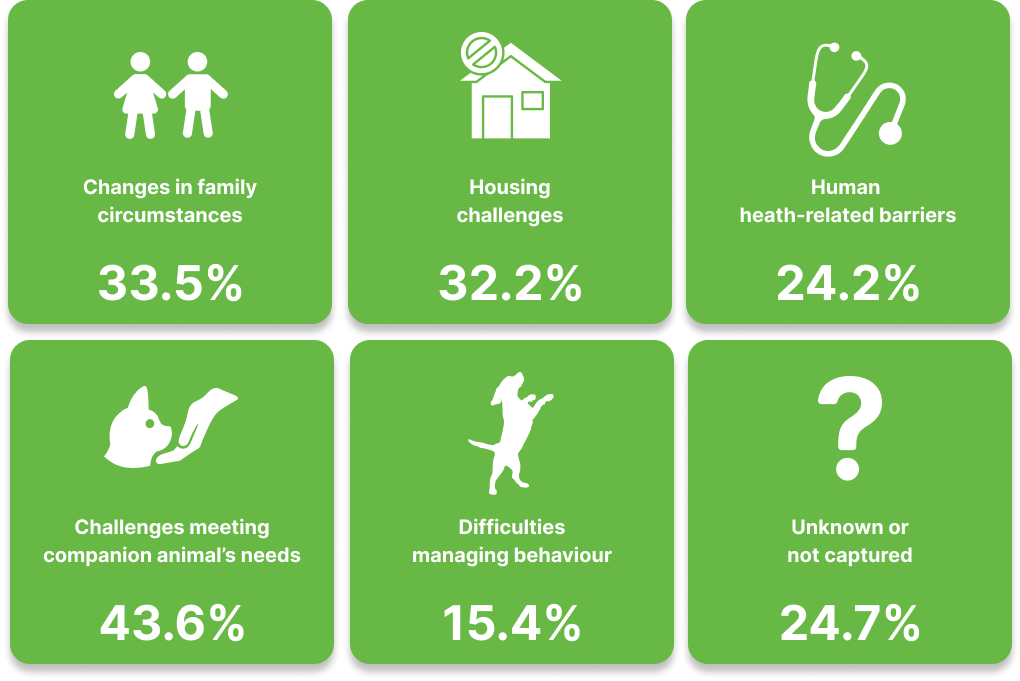
The reasons guardians gave for rehoming through Home2Home this year centred on ongoing challenges: meeting the pet’s needs, changes in family circumstances, housing and health. Finding Another Way Home found a similar pattern in rehoming requests over five years before this dataset.
These pressures rarely arrive alone and are almost never about a guardian not caring. Housing insecurity, financial hardship and family violence also run through Tailored Pet Support requests, which suggests the service may reach some guardians earlier, when temporary help could let them keep their pet.
This report treats relinquishment as shaped by systemic, overlapping pressures rather than individual failure. For a fuller picture, see PetRescue’s Finding Another Way Home: Five Years of Assisted Rehoming Insights.
What happened to pets in Home2Home
Half of the pets in Home2Home (157 of 314, 50.0%) either stayed with their guardian or found a new home. 78 of 255 cats (30.6%) were adopted through Home2Home. Nine of the 22 other pets were also adopted this way. Only 13 (4.1%) of Home2Home pets were known to have been relinquished to a rescue or shelter.
The outcome is not known for about one in three pets for which a case was opened (102 of 314, 32.5%), because the guardian stopped responding, no outcome was recorded or the case was closed due to ineligibility.
Jump to specific insights from the report: