


The State of Pet Adoption Report 2023-2024 - Introduction
Jump to specific insights from the report:
|
1. |
Introduction (current page) |
12 mins |
|
2. |
15 mins |
|
|
3. |
23 mins |
|
|
4. |
19 mins |
|
|
5. |
19 mins |
|
|
6. |
19 mins |
Stats via PetRescue.com.au from 1st July 2023 to 30th June 2024.

This report is designed to enable the animal welfare community to make informed choices about advocacy and future direction. The insights include the barriers and challenges experienced by the sector’s workforce; their strengths and resources, as well as the needs and outcomes of all the pets and people touched by this work.
The annual PetRescue State of Pet Adoption report combines PetRescue platform data and insights from a nationwide sector survey, including learnings from our community to examine what is happening in Australian pet management, rescue and rehoming during each financial year.
In 2024, PetRescue strengthened the research component, collaborating with La Trobe University researchers for the sector survey. These results are being published in a series of peer-reviewed journal articles. This series of reports examines PetRescue platform data within the context of what was happening in Australia during this time that impacted the pet adoption sector and adopters.
Background
The 2023-24 financial year was again a challenging time for Australians, and this impacted the sector alongside the people and pets they support. Challenges experienced by the public and the pet adoption sector include rising costs of living, higher interest rates, and economic uncertainty, posing significant financial challenges for many Australians, in particular those with mortgages, those facing housing insecurity, and businesses navigating difficult financial conditions.
Interest rates, housing supply and purchase costs, and rental costs rose consistently throughout the year, and the number of Australians experiencing mortgage stress was at a record high by the end of the 2023-24 financial year, at 1.573 million households. The cost of food and household supplies, electricity and other essential items increased in 23-24 following a downward trend in 2022.
In addition to the rising cost of living, the veterinary sector continues to experience rising costs of regulation, education to maintain registration, and increased cost of service provision, which in turn increases the costs of veterinary care for pets in the rescue system, in addition to increased financial stress for the sector, particularly for not-for-profit and charity organisations.
While charitable giving rose 5.6% in the 23-24 financial year, expenses reported by charities rose more than twice this percentage, with a 12.6% increase. This shortfall has been especially impactful for smaller charities, which receive disproportionately smaller funding compared to large and extra-large charities. Additionally, the ACNC and Federal Government increased scrutiny on charitable spending and Not For Profit reporting, following a sharp increase in complaints about misuse of funds by Australian charities.
Natural disasters during this period included eight major bushfires, four major flooding events, five major storms, and four cyclones. PetRescue data indicated significant changes in adoption patterns in Queensland, coinciding with flooding events in early 2024, while no other states showed notable changes correlating with natural disasters.
Big picture observations

PetRescue activity highlights for 2023–24
Over 68,000 pets were listed for adoption on PetRescue.com.au in 2023–24. More than 61,000 users created adopter profiles, and 37,855 adopters were new to pet ownership. Victoria led in total adoptions by state.
Despite fewer enquiries per profile, more pets were adopted overall compared to the previous year. Notably, 1,255 bonded pairs of pets were adopted together.

Summary of pet adoptions on PetRescue (2022–23 vs 2023–24)
This chart compares total pet adoptions by organisation type on PetRescue across two financial years. Rescue Groups led adoptions both years, with over 31,000 each year. Shelters followed with stable numbers around 25,000. Councils saw a rise from about 5,000 to 6,000 adoptions, while Vets remained steady with around 1,000. The number of active groups is noted for each type, showing Rescue Groups as the most common organisation type.
PetRescue member organisation insights
In the 2023-24 financial year, Rescue Groups together adopted 32,539 pets into new homes, an increase of 1,081 pets from the previous financial year. Following a 45% increase in the number of pets adopted out by Shelter members during the 22-23 financial year, Shelters adopted 327 fewer pets, a total of 25,186, during the 23-24 financial year. Consistent with feedback from the pet rescue and adoption community, this likely indicates that both Rescue Groups and Shelters are functioning at capacity and unable to increase throughput of pets sustainably.
Encouragingly, Council members adopted 6,073 pets directly into homes this financial year, an increase of approximately 47% on the previous year. This followed a 50.7% increase in pets adopted during the previous period, indicating that council members have approximately doubled their direct rehoming of pets on PetRescue over the last two financial years. This indicates increased placement of pets directly into adoptive homes by councils, minimising their time within the management and welfare system and providing live outcome pathways outside of Rescue Group and Shelter transfers.
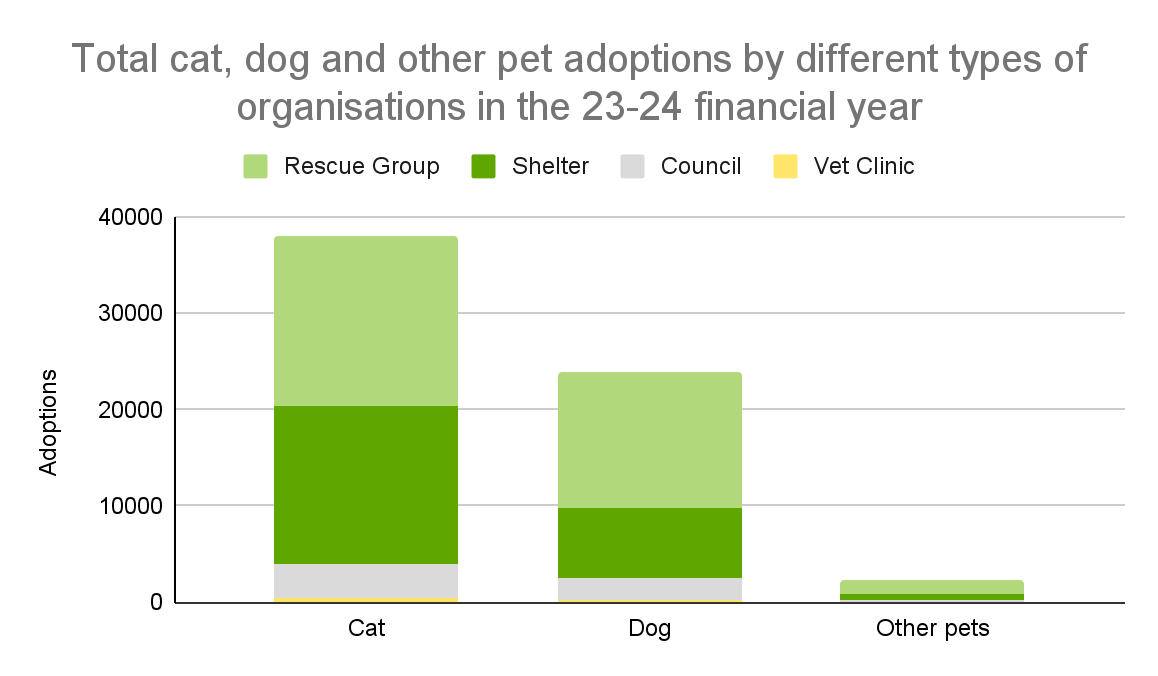
Pet adoptions by animal type and organisation (2023–24)
This chart shows total adoptions of cats, dogs, and other pets during the 2023–24 financial year, broken down by the type of organisation that found them homes. The breakdown of organisation type for cats and dogs is different - shelters adopt out almost as many cats as rescues, but only half the number of dogs compared to rescues. Councils have a similar breakdown (more cats than dogs) but at a much smaller scale.
Pet adoption insights
Cats were again the most commonly adopted pet on PetRescue.com.au. Consistent with the previous financial year, the majority of adopted dogs (14,090) were placed into their new homes by rescue groups, while shelters rehomed approximately half this number, with 7,172 dogs adopted. Additionally, councils facilitated the adoption of 2,374 dogs directly into new homes.
Cat adoptions were more evenly distributed between rescue groups and shelters, with 17,689 cats rehomed by rescue groups and 16,344 by shelters. Councils placed 3,579 cats directly into new homes, while Vet Clinic members adopted out 448 cats, 160 dogs, and 25 pets of other species.

Adoption performance snapshot (2022–24)
Pet profile views rose from 24.1M to 28.6M. Enquiries dipped from 107K to 92K. Adoptions slightly increased from 62.6K to 64.4K.
This summary reflects stronger visibility but fewer enquiries, with a modest lift in actual adoptions.
Once again this financial year, despite various cost-of-living pressures, there were a high number of adopters opening their hearts and homes to rescue pets.
During the 23-24 financial year, an increase was observed in both pet profile views and adoptions compared to the previous period, with a 19% rise in pet profile views and a 2.9% increase in adoptions. Conversely, there was a 21.8% reduction in new account creations, with 61,044 individuals creating adopter profiles for the first time compared to 78,000, in order to assist their journey in finding a pet to adopt.
Of these new profiles, 49,426 people submitted a total of 92,437 enquiries about pets available for adoption on PetRescue, reflecting a 4.2% decrease in enquiries. While the overall number of enquiries decreased, which can be partly attributed to a new feature requiring adopters to hold an account before being able to submit an enquiry, the adoption numbers were positive.

Average enquiries per pet listing (Q3 2021 – Q2 2024)
Enquiries per listing for dogs and cats dropped sharply in early 2022, then stabilized. Interest in other pets stayed consistently low throughout.
A marked dip aligns with the rollout of the “Enquiry Wall” in mid-2022, suggesting a direct impact on how often potential adopters reached out.
The enquiry wall was implemented in response to the significant workload for rescue organisations associated with reviewing applications. Despite the reduction in enquiries, the increase in profile views and adoptions indicates fewer casual enquirers and more serious potential adopters using the platform. This suggests that the enquiry wall has had the desired effect, and we do not anticipate further significant decreases in adoption enquiries.
Despite continuing financial and housing challenges for pet owners in Australia, adoption demand for pets on PetRescue has remained strong. Positively, the median time to adoption in days for the year reduced by 4.4% for dogs to 19.96 days, 20.5% for cats to 11.19 days, and a significant 33.9% for other species of pet to 16.04 days. Similarly, the average number of days between listing and adoption for all species has remained steady since 2022, with one significant spike for all species categories during the first half of 2024 (see graph below).
Average days to adoption over time for dogs, cats and other species of pets

Average time to adoption for different species (Jul 2022 – Jun 2024)
All species of pet—Dogs, Cats, and Other—saw a dramatic listing spike in March 2024, with “Other” species of pet briefly outnumbering Dogs and Cats. Smaller, periodic peaks occurred throughout the timeline, especially for dogs in Aug 2022 and “Other” pets in Dec 2022.
The temporary spike in the average time to adoption coincides with widespread flooding in Queensland.
PetRescue platform data shows this spike was related to a significant but temporary decrease in adoptions in Queensland, coinciding with the widespread flooding experienced by large areas of the state.
Altogether, this data indicates that adoption demand for all species remains strong. One potential driver of the strong adoption interest observed, despite economic and housing pressure on pet owners, is the decrease in average age of dogs and cats listed on the platform over time (see graph below).

Adopted pet age trends (2020–2024)
The average age of adopted pets via PetRescue has gradually declined over the past four years. Dogs are consistently older at adoption than cats, though both species show a downward trend.
The average age of pets coming in to adoption organisations has become younger, possibly indicating that more puppies and kittens are coming in to care over time.
This increase in the proportion of young dogs and cats entering the rescue system over time has also been reported anecdotally by PetRescue members. As younger pets are typically adopted faster than older ones, and demand for puppies and kittens tends to remain high even when less popular cohorts of pets experience reduced adoption demand, this could explain the strong median days to adoption values observed. This is of concern to the sector, as it potentially indicates increasingly poorer control over the casual or uncontrolled breeding of dogs and cats. Additionally, puppies and kittens are at increased risk of infectious disease and long-term negative health and behavioural impacts from sheltering compared to healthy adult pets. As such, increasing numbers of infant and young pets in the system over time is not inherently positive.
Concurrently with the trend towards an increasing number of younger pets in the system, we are seeing indicators that a growing cohort of pets are waiting longer for their homes, such as increasing average days to adoption over time.

Time to First Pet Enquiry – Quarterly Trends
Regarding the time it takes for a pet to receive their first enquiry after being listed, the trend for both dogs and cats over time is upwards, with the upwards trend being more notable for cats than dogs.
This data suggests “Other” species of pets may face more unpredictable adoption interest—perhaps due to seasonal trends, niche appeal, or listing quality.
The average days to adoption for cats tripled from 12.87 days to 46.89 days between mid-2021 and mid-2024. Similarly, for dogs, the average number of days between listing and adoption rose from 14.23 to 33.9 during the same period. This trend is also evident in the growing percentage of pets taking longer than 60 days to be adopted once listed.

Long adoption timelines (60+ days) – Q4 2021 to Q2 2024
All species (dogs, cats, others) had a strong upward trend of pets who took longer than 60 days to find a home, with notable variability over time. Dogs and others trended upwards more dramatically than cats, but all types of pet are affected.
-
Cats consistently had the highest share of 60+ day adoptions across all quarters.
-
Dogs remained steady, with moderate long-duration adoption rates.
-
Other pets saw more volatility, including a visible spike in early 2024.
This highlights species-based differences in adoption urgency, with cats facing longer delays overall.
For all species, the proportion of pets waiting more than 60 days to be adopted increased from approximately 5% to between 20% and 30%. The reduction in median and the increase in average time to adoption, along with the rise in the percentage of pets waiting two months or more, suggest that while most pets are being adopted somewhat faster over time, a small but increasing segment of pets is experiencing significantly longer adoption periods.
Although these ‘longer stay’ pets eventually find loving homes, for both individual pet welfare and system capacity reasons, it is crucial to identify which pets make up this cohort. Understanding which pets make up this cohort will allow the sector to focus efforts on making these pets more visible and appealing to potential adopters, in order to accelerate their adoption into homes.
The sections of this report dedicated to cats, dogs, and other pets provide a more detailed analysis of PetRescue platform data to identify these pets and the factors influencing their adoption journey.
Who is adopting pets?
Every happy outcome for a pet adopted in Australia is the story of an adopter who finds love with their new furry family member. Much of what we know about adoption trends comes from research and data analysis from the United States of America. While Australians and Americans have a lot in common, better understanding Australian adopters enables us to match them more quickly with their new pets.

Adopter Demographics & Behaviour Snapshot
-
Typical adopter profile: 2 adults, one third with children, often no other pets.
-
Over 74,000 completed profiles, showing strong engagement.
-
Adopters made an average of 3.5 pet enquiries and sent 2.9 messages per enquiry.
This points to a highly invested adopter base, with thoughtful consideration before reaching out.
In 2023, the average Australian household consisted of 2.5 people. Of the 9.275 million households in Australia, 72% have children. In contrast, the typical adopter visiting PetRescue in search of their new pet is from a household of two adults, and only one in three potential adopters have children.
Interestingly, fewer potential adopters visiting PetRescue already had pets (48.9% of adopter profiles) compared to 69% of homes in the general population. Additionally, data from the PetRescue platform reveals that most enquiries come from people living in postcodes with above-average Socio-economic Advantage and below-average Disadvantage.
While PetRescue member organisations are spread fairly evenly across SEIFA Deciles, Australian research indicates that a disproportionate number of pets entering our animal management and welfare system, especially those relinquished by their care takers and community cats, come from low socioeconomic communities (see graph below).

Pet listings & adoption engagement summary
Adoption enquiries are strongest in high SEIFA deciles (9–10), while member organisations are more common in mid-decile areas (4–7).
This points to a potential disconnect between adoption interest and rescue group locations.
This contrasts with findings from the USA, where it has been observed that pets, especially stray pets, are more likely to enter shelters from communities with lower socio-economic profiles due to a higher representation of municipal shelters (relative to not-for-profit) shelters in these areas. However, pets from areas of higher vulnerability were no more likely to be euthanised, and pets were adopted across all community types equally.
This perhaps indicates that the Australian sector has two board approaches available to drive down intake and reduce demand on the limited capacity of the system; follow the lead of the USA and reduce intake of pets by improving owner support services to keep pets with their existing families and broaden the potential adopter population by reducing barriers to pet adoption for people in lower socio-economic communities.
Examination of pre-adoption behaviour and considerations of dog adopters of different socioeconomic status found that all adopters experienced similar pre-adoption decision making processes, and were motivated primarily by a desire for companionship. Those from higher-income households, however, were more likely to obtain a pet through an online source unknown to them, compared to people from lower-income brackets who generally obtained their pets through personal contacts.
Jump to specific insights from the report:
|
1. |
Introduction (current page) |
12 mins |
|
2. |
15 mins |
|
|
3. |
23 mins |
|
|
4. |
19 mins |
|
|
5. |
19 mins |
|
|
6. |
19 mins |