


The State of Pet Adoption Report 2023-2024 - Dog Adoption Insights
Jump to specific insights from the report:
|
1. |
12 mins |
|
|
2. |
15 mins |
|
|
3. |
23 mins |
|
|
4. |
Dog Adoption Insights |
19 mins |
|
5. |
19 mins |
|
|
6. |
19 mins |
Stats via PetRescue.com.au from 1st July 2023 to 30th June 2024.

Overall observations and trends
Dogs remain the most popular pet in Australia, with approximately 48% of households owning at least one of the country’s 6.37 million pet dogs*. This financial year, 23,853 dogs found new families via the PetRescue platform, an increase of approximately 2,600 dogs from the previous period.
The PetRescue member community is reporting an increase in puppies coming into care, along with a decrease in capacity for pets. Platform data indicates that dog adoption patterns vary by state, but overall, both dog adoption numbers, as well as the median time to adoption, are dropping.
This section of the report explores the trends and patterns in platform data related to dog adoption to identify areas that the sector can focus their efforts on to improve dog adoption outcomes.


Dog listings and adoptions across the country have continued to increase over time, but have not yet reached pre-pandemic levels. While listings and adoptions of dogs across all age cohorts increased during the 2023-24 financial year, there was a decrease in median profile views. This is consistent with overall findings from the platform for all pets and the reduced time to adoption for dogs at a national level, as time to adoption and profile views typically correlate.
Generally, dog adoption numbers are still strong, but we are seeing some signs that demand may be weakening for some cohorts of dogs.

Across all states, Victoria was the strongest performing for dog adoptions, with improvements in both time to adoption measures, indicating that dogs are moving more quickly into homes in Victoria than previously, despite the average time to first enquiry for pets increasing slightly.
New South Wales experienced a decrease in median days to adoption, coupled with an almost 40% increase in average days to adoption. This indicates that while the majority of dogs in NSW are being adopted slightly more quickly than the previous year, a cohort is taking significantly longer to find homes.
Several states, including Queensland, Western Australia, South Australia, and the Northern Territory, experienced the opposite trend in dog adoptions, with increases between 3% and 35% in the median days to adoption, and decreases between 19% and 83% in the average days to adoption. This indicates that in these states, dogs are generally moving more slowly to adoption and the pool of ‘slow to adopt’ dogs is decreasing in size. The cause of this decrease is unclear from this data.
Tasmania was the only state in which all adoption metrics pointed towards a strong decrease in demand during the 2023-24 financial year. However, this data is based on just 24 dogs adopted in Tasmania during these 12 months, so it may simply be an anomaly.
As expected, due to the implementation of the enquiry wall, most states experienced a drop in the average number of enquiries for dogs. The two exceptions were the ACT and Northern Territory, which saw significant increases in dog enquiries.
Barriers affecting adoptability
On the PetRescue platform, member groups can elect to indicate on a pet's profile if they would be suitable, or not, to live with other pets or with young or school-aged children.
It is recognised that adoption restrictions negatively impact the time to adoption (or length of stay in shelters) of dogs. Common restrictions include those related to medical conditions and restrictions on the type of homes that dogs can be placed in, typically due to challenging behaviours that have been observed while in care or suspected compatibility issues that may impact the success of an adoption (e.g. excitable large breed dogs are commonly restricted to homes without children).
As expected based on previous research, platform data indicates that easy-going dogs who can live with other dogs, cats, and children are adopted significantly more quickly than those advertised with living restrictions.

Graphic showing various adoption restrictions (such as not being able to live with other dogs) for dogs and the impact this has on adoptions, average days to first enquiry, average number of enquiries, median days to adoption and the percentage of dogs adopted after 60 days. Of the restrictions recorded on the platform, being unable to live with children under 5 was the least impactful restriction, while being incompatible with other dogs was the most impactful
Of the restrictions recorded on the platform, being unable to live with children under 5 was the least impactful restriction, while being incompatible with other dogs was the most impactful, leading to more than double the average time to first enquiry and adding an extra eighteen days to the median adoption time. Surprisingly, dogs labelled as incompatible with children between 6 and 12 years of age were, on average, the fastest cohort to receive enquiries, while being among the slowest cohort to be adopted.
This data highlights the negative impact of blanket restrictions sometimes imposed by member groups, and restrictions placed on individual dogs based on unconfirmed behavioural incompatibilities (e.g. organisations restricting the adoption of all or most large-breed dogs into homes with other dogs).
While accurate matching of adopter expectations with the reality of living with their new pet is important for adoption success, prolonged length of stay is both resource-intensive and, when dogs are kept in kennel environments, can lead to behavioural and physical deterioration and even euthanasia. As such, restrictions must be only placed on pets with known requirements for a specific type of lifestyle and family to minimise the negative impacts of restrictions on their journey to their new life.

When examined over a longer time, adoption restrictions related to compatibility with dogs increasingly negatively impact adoptability. The median days to adoption for dogs labelled as not compatible with other dogs on their PetRescue profiles have almost tripled, from 22 in June 2020 to 61 days in June 2024. Over the same period, the median days to adoption for dogs with no dog-related restrictions increased only 50%, from 18 days to 27 days.
External and environmental factors impacting adoptable dogs
In addition to the factors affecting adoption at a national level discussed in the Introduction, a number of factors have been identified by the sector and in the 2022-23 State of Pet Adoption Report that impact dog adoption in Australia.
As of May 2024, the tick-borne disease Ehrlichia canis is now considered established in Australia. As such, it is no longer a notifiable disease, and all remaining movement restrictions on dogs from areas with known E. canis infections were lifted at this time. This disease is transmitted between dogs by the brown dog tick, and dogs cannot directly infect each other.
E. canis is confirmed as present in WA, NT, SA, and QLD, and over time, is likely to spread across the full range of the brown dog tick in Australia, including northwestern New South Wales. The lifting of movement restrictions may positively impact dog adoption numbers in affected areas, as transport of dogs to other areas for adoption resumes. However, as Australian adopters are relatively unaware of E. canis, including the management, treatment, and severity of the disease, it is difficult to predict what the response of the public to dogs from these areas may be.
Additionally, several Australian states have recently or are planning to amend domestic animal management and rehoming legislation, including Victoria, New South Wales, Queensland, South Australia and Western Australia. PetRescue is monitoring patterns in pet adoptions across all of these states for changes that may be related to these legislative updates.
Highest risk cohorts identified
PetRescue monitors platform data to identify cohorts of pets that may be at higher risk of being overlooked, becoming lost in the system, or waiting for extended periods before adoption. PetRescue also collates information from member organisations and others within the sector about adoption trends they are noticing to inform this analysis.
The measures used to monitor to assess high-risk cohorts include time to first adoption enquiry once a profile is listed, pet cohort average and median time to adoption, and the percentage of pets within a cohort that take longer than 60 days to find a new home. Trends over time are typically more informative about high-risk cohorts than short-term changes that impact a group of pets for a finite time (e.g. pets in an area impacted by natural disasters will experience temporary challenges finding homes).
Anecdotal reports from the sector during this financial year were that council and shelter members were seeing more puppies come into care than ever before, and they were experiencing challenges finding homes for these puppies who were ‘growing up in care’ as a result of prolonged waits for adoption.
Additionally, all types of member organisations reported concerns about medium and large breed dogs taking extended times to find homes. Below, we examine PetRescue adoption metrics by age, size, and both factors combined to identify which cohorts of dogs are currently experiencing the greatest challenges finding new homes.
Adoption outcomes by age
Age categories on PetRescue are assigned at the time the pet’s profile is created, which means that some puppies and adolescent dogs will have become adolescents or adults by the time they are adopted.

The speed of enquiries and adoptions is positively correlated with age, with puppies on average receiving their first enquiry in less than half the time that adult dogs wait and experiencing a median time to adoption during the 2023-24 financial year that was three days shorter than the 20 days waited by adolescent and adult dogs.
Generally, the overall number of enquiries a pet receives is reflective of the length of time they are listed, with pets listed for longer receiving more enquiries in total. However, during the 2023-24 financial year, puppies on average received one enquiry for every 2 days listed, while adolescents received 1 enquiry for every 3 days listed, and adult dogs received one enquiry every 3.5 days.
For both adults and puppies, the average time to first enquiry increased in the 2023-24 financial year compared to the previous year, with puppies’ average time increasing by 9 days to 69 days, and adults’ average time increasing by 18 days to 175 days. Additionally, the average time to first enquiry for adolescent dogs decreased, dropping from 14 days to 114 days from listing to first enquiry.

While we continue to see a steady recovery of dog adoption numbers across all three age cohorts following the pandemic, the number of puppy adoptions has increased significantly faster than adolescent and adult dog adoptions, with an average of 458 puppies adopted per month in the second half of 2021, increasing to 760 per month in first half of 2024.
Adolescents were the cohort closest to recovering to pre-pandemic listing numbers at the end of the 2024 financial year. The dog adoption rate, or the proportion of dogs listed on PetRescue that are eventually marked as adopted, dropped over the 2023-24 financial year, as indicated by the increasing gap between the listing and adoption lines for each cohort in the above graph. This may indicate a mild weakening of adoption demand during this financial year and is most notable for adult dogs, followed by adolescents.
While since the third quarter of 2020, adoptions of dogs aged less than 12 months (puppies and adolescents) has consistently increased, total numbers had still not reached pre-pandemic levels at the end of the 2023-2024 financial year, indicating that anecdotal reports of extremely high numbers of puppies in care were reflective of a return to ‘pre-pandemic’ numbers rather than an all time high in puppy numbers.

However, PetRescue has noted changes in the proportion of young dogs listed by different types of PetRescue member organisations over time, and this may go some way to explain reports by members of high numbers of puppies. Councils, and, to a lesser extent, shelters are experiencing a steady but mild increase in the proportion of young dogs they are directly adopting into homes.
At the end of 2023, these numbers were still below 2015 and 2016 figures, and shelters are not seeing the same size increase that councils are. In contrast, post-pandemic, the percentage of young dogs being cared for by rescue groups has slightly dropped year on year, from 72% in 2020 to 65% in 2023.
Given the consistent indicators that rescue groups across Australia are functioning at or above capacity, these changes together likely indicate a correlation with Councils, and, to a lesser extent, Not-For-Profit shelters increasing their capacity for direct adoptions due to lack of pathways for pets through overwhelmed rescue groups.

Over time, the median number of days to adoption, which indicates the length of time most dogs wait for adoption, has converged for the three different age cohorts. The median days to adoption for adolescent dogs has remained relatively steady, while puppies took slightly longer and adult dogs less time to be adopted in June 2024 compared to July 2021. These changes in median time to adoption are consistent with the steeper increase in puppy numbers during this time, compared to the numbers of adults and adolescents.
It’s unclear from platform data whether young dogs are entering care as puppies and not being adopted until they are adolescents, as reported by some member organisations. However, despite a relatively short median time to adoption for puppies of 17 days, the average time to first enquiry for puppies during the 2024 financial year was 69 days (or just over 2 months), indicating that some puppies are taking considerable lengths of time to find homes. This supports anecdotal reports of some puppies ‘growing up in care’ and indicates that young dogs, especially puppies, are increasingly a cohort to be concerned about.
Adoption outcomes by size
As expected, based on long-term trends, small dogs listed on PetRescue receive more enquiries and are adopted significantly faster than medium and large dogs.

During the 2023-24 financial year, the median time to adoption for small dogs was 8 days faster than that of medium-sized dogs and 11 days faster than for large dogs. Small breed dogs received almost five times the number of enquiries compared to large breeds, despite being listed for a shorter time on average. One in six small dogs waited longer than 60 days to be adopted, compared to one in four medium dogs and almost one in three large breed dogs.

Quarterly adoption trends since July 2018 indicate that while all dog size cohorts saw a temporary drop in the number of dogs available for adoption during the pandemic, large dogs experienced the smallest drop in dog adoptions during the pandemic. Since the pandemic, adoptions of large dogs have nearly fully recovered to pre-pandemic levels.
Similarly, while small dogs are the smallest size of cohort available and adoptions were heavily impacted by COVID, small dog adoption numbers had almost fully recovered to pre-pandemic levels by the end of the 2023-24 financial year.
In contrast, medium-sized dogs are the largest cohort of dogs listed on PetRescue and were the most impacted cohort during COVID, with quarterly adoption numbers approximately halving during the pandemic. The amount of medium-sized dogs available for adoption has been consistently increasing post-pandemic, with an extra 1,000 medium dogs adopted each quarter. However, total adoptions of medium-sized dogs are still well below pre-pandemic highs and are climbing.

While the number of medium-sized dogs being adopted is still consistently climbing, the monthly median time to adoption has also steadily increased from approximately 15 days in mid-2020 to approximately 22 days in mid-2024. This indicates that the majority of medium-sized dogs are waiting increasingly longer to find adoptive homes once made available for adoption. Platform data indicates that the majority of dogs in this size cohort are herding breeds, bull breeds, and mixtures of these types.
For both large and small dogs, the monthly median time to adoption has remained steady over the same four-year period, at approximately 25 days for large dogs and 13-14 days for small dogs. It should be noted that some large and medium-breed puppies are listed as small dogs when made available on the platform, potentially skewing small dog adoption numbers upwards.
Along with increasing total adoptions for medium-sized dogs, the consistent increase in median time to adoption indicates that medium dogs are a cohort of high concern, as the amount of these dogs looking for homes is continuing to climb despite indicators of weakening adoption interest.
Combined effects of age and size on adoption outcomes
When both age and size of dogs are combined, greater resolution in adoption patterns is apparent.
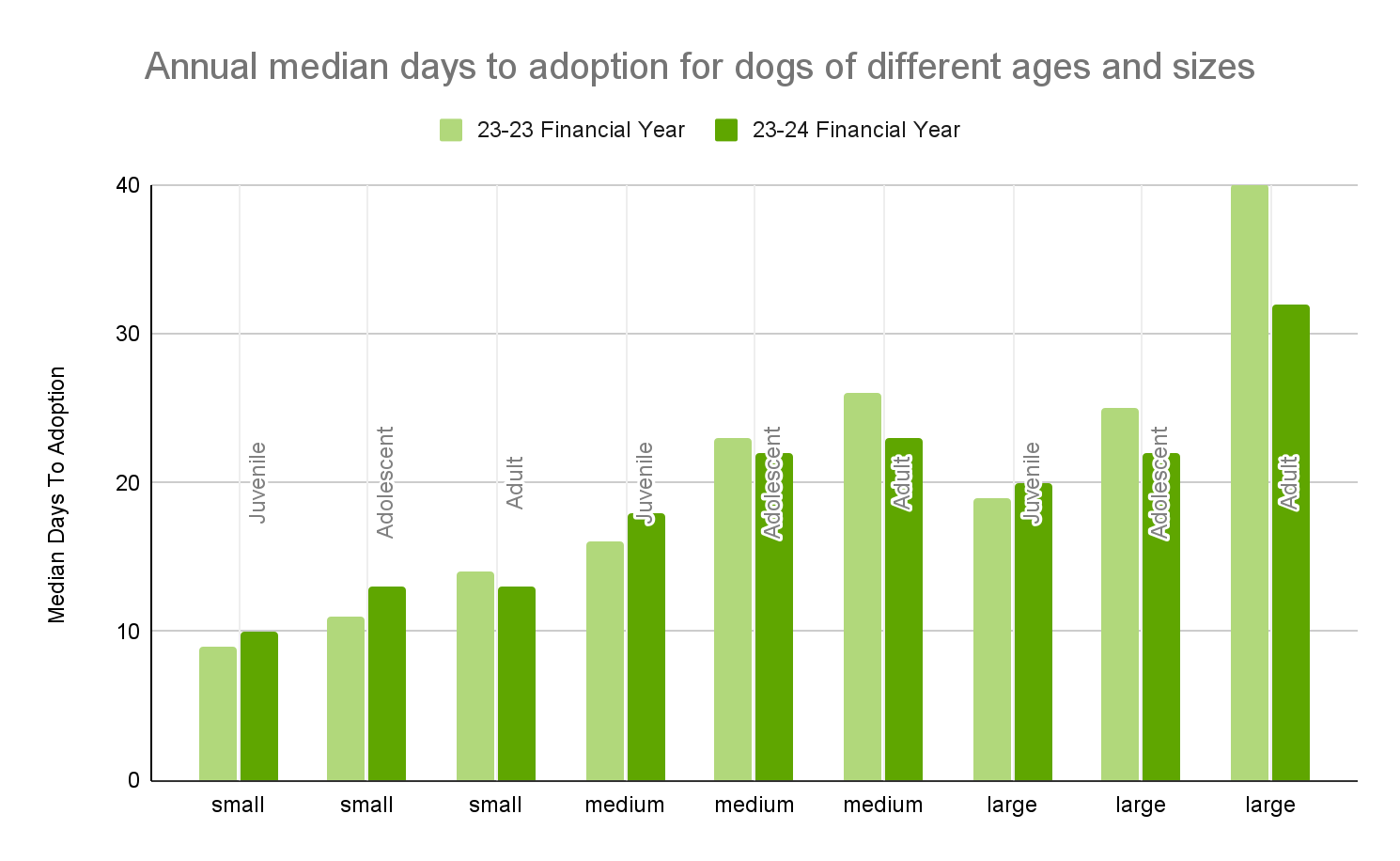
Puppies of all sizes, and small adolescent dogs were the only cohorts for which the median days to adoption increased in the 2024 financial year compared to the previous year. All other cohorts experienced a drop in median time to adoption, with the largest drop in median days to adoption observed for adult large dogs.
This indicates that for all dogs other than puppies and small adolescents, the majority found homes faster in the 2023-24 financial year than in the year before. The number of young, small dogs available on PetRescue is low compared to dogs of other sizes and ages. Additionally, these two cohorts have the lowest time to adoption for any dogs, so this increase is not an immediate concern. However, the situation with small dogs will continue to be monitored over time.

When the proportion of dog adoptions that took longer than 60 days was compared to the same cohorts across the last two financial years, the only dog cohorts not to experience an increase in the percentage of longer-term adoptions were small puppies and large adult dogs. This analysis confirmed that puppies and medium dogs are the main cohorts of concern as these groups experienced the greatest increase in the proportion of dogs waiting more than two months to find a home.
Coupled with the consistent increase in the number of medium-sized dogs available for adoption, this indicates that medium, and to a lesser degree, large-breed puppies which experience consistently longer waits for adoption, are the current dog cohorts of greatest concern.
The current understanding of these trends is that medium-sized dogs, in particular puppies, are increasingly more prevalent in the adoption system and are experiencing longer wait times due to this. Whereas large-breed puppies are not more common than they previously were, however, demand for large-breed puppies is weakening.
Source: Pet Ownership Report - Animal Medicines Australia
Jump to specific insights from the report:
|
1. |
12 mins |
|
|
2. |
15 mins |
|
|
3. |
23 mins |
|
|
4. |
Dog Adoption Insights |
19 mins |
|
5. |
19 mins |
|
|
6. |
19 mins |