


 Sharing skills to make desexing more accessible for cats
Read more
Sharing skills to make desexing more accessible for cats
Read more

Whether you've found a cat you're trying to reunite with their guardian or a litter of kittens in your community, it's natural to feel concerned.
You might be wondering: is this cat lost, living as an urban stray cat, or whether the kittens need help right now. You've made the right move by seeking advice.
If a cat or kitten appears sick, injured or unable to stand, seek veterinary advice as soon as possible. Take care when approaching or handling an unfamiliar cat so you don't put yourself at risk.
To help you work out the next step, use the decision tree below or you can download it as a PDF (with clickable links).
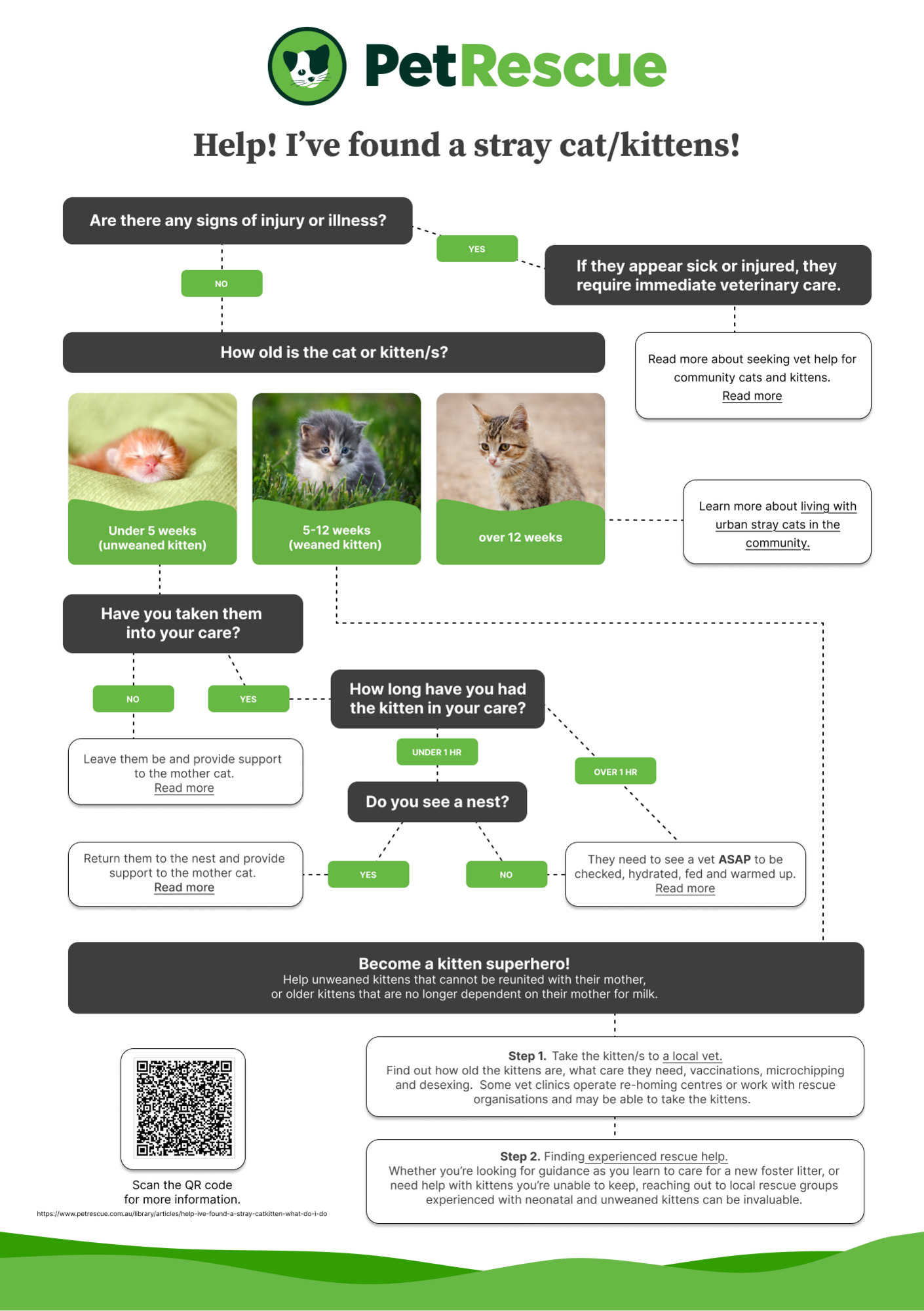
Are there any signs of injury or illness?
How old is the cat or kitten/s?
Have you taken unweaned kitten/s into your care?
How long have you had the unweaned kitten/s in care?
Finding experienced rescue help
Lost pet or an urban stray cat?

Are there any signs of injury or illness?
If they appear sick or injured, they require immediate veterinary care. You can find a vet clinic here.

Take care to stay safe when containing and transporting cats. Use a secure cat carrier for older or stressed cats if available, and for young kittens, a sturdy cardboard box with high sides and a towel inside will work.
See below for common signs of poor health.
In kittens common signs of poor health include:
-
Being thin (baby kittens should have a visible pot belly)
-
Build up of mucus or crusties on the eyes or nose (common indicator of infections)
-
Noisy breathing
-
Kitten coats naturally are quite fluffy and dry. If the coat is flat, wet or appears to have build up on it, this is a sign that they require help
In adult cats, common signs of poor health include:
-
Low body weight
-
Rough or poor quality fur coat, patches of hair missing or visible scabs (be conscious of ringworm as this is zoonotic and you can become infected while handling cats with ringworm)
-
Build up of mucus or crusties on the eyes or nose (common indicator of infections)
-
Noisy breathing
-
Lameness or uneven gait
-
Any visible signs of injury
*** If a cat or kitten is lying down and seems unable to stand, or appears injured and immobile, use thick gloves or a thick blanket to lift them into a carrier, as they may be in pain and could bite. Do not risk being bitten or seriously scratched if you don’t have appropriate equipment to contain and move them safely.
Choosing a vet clinic
Vet clinics vary in their ability to help stray pets. Look for clinics that already support community cats, such as offering services to local rescue groups or running an in-house kitten adoption program.
You can search on the internet for these by typing “community vet clinics” (clinics offering lower-cost, accessible services) or “vet clinic that works with rescue groups near me.”
Keep in mind that some clinics may not have the resources to assist stray cats or kittens and could refer you to your local shelter or another pathway. It’s always best to call ahead and check.
Use our Rescue Directory to find local rescue groups that can offer guidance.
How old is the cat or kitten/s?
Knowing a cat or kitten’s age is vital to providing the right care. Very young kittens need their mums to grow strong and healthy, while older kittens that are eating on their own need to learn how to live with humans to become happy, confident pets.

Get help estimating a kitten's age.
For adolescent (over 12 weeks) and adult cats, follow the advice for living with urban stray cats in the community.
*unweaned kitten: still relies on mum’s milk and cannot eat solids on their own.
**weaned kitten: no longer dependent on mum’s milk and can eat solids.
Have you taken unweaned kitten/s into your care?
While it’s natural for caring folks, like yourself, to scoop up baby kittens they find in the community, when young kittens are still reliant on their mother’s milk, it’s crucial to keep the family together where possible.
-
Kitten/s that show signs of injury or illness, they need veterinary attention ASAP. You can find a vet clinic here.
-
Kitten/s that appear dry, healthy and in or very close to their nest, do not require any intervention. You can continue to support the family by helping mum.
-
Find next steps if the kitten/s appear healthy and are not in a nest.
Mother cats generally do not abandon their kittens. She may be out getting food, resting, or ensuring the area is safe. This is normal behaviour, not abandonment.

Kittens under five weeks of age have very immature immune systems and their mum is best equipped to care for them.
Her role includes:
-
Keeping the kittens warm, fed, and clean
-
Teaching essential survival skills: play, hunting, and socialisation with other cats
-
Strengthening the kittens’ immune systems through her milk
Separating neonatal kittens from mum greatly reduces their chances of survival (read more here). Rescue groups face significant challenges caring for unweaned kittens without their mother, and even experienced and well resourced neonatal kitten carers often lose kittens because they are so fragile.
How long have you had the unweaned kitten/s in care?
If you have taken unweaned kitten/s into care, please don’t panic! Mum will be looking for them and she will not reject the kitten/s even if they have been with you and smell like humans.

Over an hour or can’t locate the nest:
If you:
-
Had them in care for longer than an hour
-
Can’t locate the nest
-
They have gotten cold
They need to see a vet ASAP to be checked, hydrated, fed and warmed up.
You can find a vet clinic here.
Under an hour and can see the nest:
If you:
-
Had them in care for less than an hour.
-
Have kept them warm and appear healthy.
-
Can see the nest
Click here if you can see a nest.
Do you see a nest?
If you can see the nest, pop the kitten/s back and watch the nest over the next couple of hours to see if mum comes back. Some mum cats won’t return if you are nearby, so you can sprinkle some plain flour around the nest to capture her footprints and then leave the kittens be - just remember to come back in 1-2 hours to check.

If the mum returns, then you can step back in the role of supporting mum! Read more about helping mum.
If you can’t find the nest or the mum doesn’t return, then you can be a superhero to these kitten/s. Read more here.
Helping mum

What every mum needs most is just a bowl of water and some food. Grab some meat or tinned fish if you don’t have cat food available.
Take great care not to frighten her! Move quietly and slowly and leave her alone while she eats. If the kittens are mobile, they are probably old enough to eat as well, so make sure you allow extra for them.
Observe while feeding:
-
Count the kittens
-
Check their health and size
-
Assess mum’s temperament: is she timid or friendly?
This information is important to know, as once the kittens are big enough to eat independently, at around five to six weeks, it’s the right time for them to be fostered and mum to be desexed.
For further reading visit: www.alleycat.org/take-action/leave-them-be/
Become a kitten superhero!
Do you have the capacity and support to take on and foster the kitten/s while they grow up and are prepared for adoption? You can be a superhero to unweaned kittens that cannot be reunited with their mother, or older kittens that are no longer dependent on their mother for milk.
The first thing you need to do is take the kittens to a local vet clinic for assistance to find out how old the kittens are, what care they need, vaccinations, microchipping and desexing. Some vet clinics operate re-homing centres or work with rescue organisations and may be able to take the kittens.
If you can step in and become their temporary family it’s important to understand what’s involved with caring for kittens before you jump into fostering, so you know if you have the capacity to help effectively.
For unweaned kitten/s:
-
You are taking on the role of their mum and that involves round the clock care
-
Read about what’s involved in raising unweaned kittens here
-
If you are a first time carer and would like to take on the role of fostering unweaned kittens, it is best to find an experienced mentor

For weaned kitten/s:
-
House the kitten/s in a quiet, spare room, laundry or bathroom
-
Provide two litter trays and a bed, which can be bought cheaply from a discount shop
-
Kitten/s may be timid at first, but getting them used to your presence will help them to trust
-
Encouraging gentle socialisation is extremely important in preparation for adoption
Click here to find experienced rescue help.
For more information on taming a kitten, watch PetRescue co-founder, Vix Davy’s ‘Kitten Taming Diary’.
Finding experienced rescue help

View our Rescue Directory to find a local rescue group experienced in caring for young kittens. If you are unable to foster, you may need to contact more than one group to find one with capacity.
Not all rescue groups have experience with young kittens, so it’s best to contact those that focus on cats, especially urban stray cats, or groups that care for both dogs and cats, checking their website and asking directly about their experience.
If you’re unable to find a suitable rescue group, try a local not-for-profit shelter that cares for cats. When contacting any organisation, be clear about your capacity to help, as all support is valued and fostering is especially helpful.
Lost pet or an urban stray cat?
Before intervening, it’s important to assess whether the cat is a lost pet or an urban stray cat.

Is the cat a lost pet?
If the cat is injured, looks sick, or is very skinny, this may indicate that they are a lost pet cat rather than an urban stray cat, so it will be beneficial to seek out a microchip scan. Lost pet cats are generally never too far from home, so it’s also recommended that you take a photo of the cat to post on local community Facebook groups and lost and found pet groups for lost cats in your area.
If you think the cat might be a wandering or lost pet and they are friendly, you can make a paper collar and try attaching it with a couple of pieces of tape. On the paper collar, put a note saying, ‘Please call this number if this is your cat… (enter your contact number)’. Or, put a note to let the owners know their cat is wandering. Quite often, the owners won't even be aware!
You can find a template for a paper collar here.
Safety first!
-
If the cat seems friendly, fitting a paper collar shouldn’t be a problem
-
If the cat is nervous, please don't risk being bitten or scratched
-
Only handle cats you can safely lift
-
Contact animal welfare and rescue organisations for trapping advice.
Is the cat an urban stray cat?
Not all cats you find are lost pets! Many urban stray cats are healthy and used to living outdoors. These cats can thrive if you provide regular food, fresh water, and a warm place to sleep. If you decide to care for an urban stray cat, it’s recommended to join a Community Cat Desexing Program and follow their advice. Let your neighbours know that you are caring for the cat to prevent confusion or conflicts. By supporting urban stray cats where they are, you help keep them safe, reduce the number of cats entering shelters, and contribute to healthier, happier cats in your community.
Find out more about helping cats and the community.
Important note:
-
Lost pet cats are more likely to find their way home on their own than survive being impounded
-
One-third of cats entering council care are killed, and in some areas it is even more than that
-
Trapping and taking them to local council facilities should be a last resort


