


The State of Pet Adoption Report 2023-2024 - Pet Adoption Trends & Insights
Jump to specific insights from the report:
|
1. |
12 mins |
|
|
2. |
Pet Adoption Trends & Insights |
15 mins |
|
3. |
23 mins |
|
|
4. |
19 mins |
|
|
5. |
19 mins |
|
|
6. |
19 mins |
Stats via PetRescue.com.au from 1st July 2023 to 30th June 2024.

Sector Overview
The PetRescue website was created to showcase adoptable pets being cared for by Rescue Groups, Shelters, Councils and Vets to potential adopters across Australia. These pets have happy outcomes because of the hard work and dedication of these members, who collectively found loving homes for 64,554 pets in the 23-24 financial year.
Who are PetRescue members?
PetRescue launched in 2004 and was the first national pet adoption website connecting rescue pets from rescue groups, shelters, councils, and vets with their new families. Thanks to the dedication of these members, 64,554 homeless pets found loving homes in the 2023-2024 financial year.
PetRescue member organisations are part of a community of like-minded organisations, committed to upholding values of kindness, respect, and ethical adoption of pets. The PetRescue member community voluntarily agree to the Membership Code and Pet Listing Rules, and many proudly exceed these standards in their work.
As pet management, welfare, and adoption move into a new era of prioritising proactive, preventative approaches to keeping people and pets together, some PetRescue members are leading this movement towards new and improved best practice in the service of pets and their guardians in crisis.
In the 2024-2025 financial year, 586 member organisations listed a total of 68,285 pets on the PetRescue platform. During this financial year, 62 new organisations joined the community, including 5 councils, 6 not-for-profit shelters, 13 vet clinics, and 38 rescue groups.
Additionally, 459 new individuals were added to member organisation accounts, contributing to a community of 3,660 volunteers, foster carers, and staff represented on PetRescue. By the end of the 2023-2024 financial year, 863 member organisations had active PetRescue accounts.

Most of these organisations (83.5%) are volunteer-run rescue groups or vet clinic staff who manage small adoption programs on a volunteer basis to help pets in need within their communities. Often, these members balance paid jobs alongside their rescue and adoption roles while handling the administration and financial sustainability of their Rescues. Consequently, it is not uncommon for smaller organisations to temporarily step back from the sector. You can read more about the challenges faced by the sector in the 2022-2023 State of Pet Adoption Sector Survey Report.
Volunteer-run rescue groups outnumber Shelters and Councils combined by approximately four times on PetRescue. These rescues collectively rehomed 50.4% of the pets who found homes through the PetRescue website, demonstrating the incredible outcomes achievable when the community works towards a common goal. The remaining 49.6% of pets were primarily adopted out by 87 Shelter members (39% of adopted pets), Councils (9.4% of adoptions), and Vet Clinics (1% of adoptions). On average, individual Shelters listed more than 15 pets each per month, Councils listed approximately 10 pets each, and Rescue Groups listed 2-3 pets per month each.
As noted in the 2022-23 State of Pet Adoption Report, the majority of PetRescue members use informal record-keeping systems for their management of pets in care, such as paper-based records or Microsoft Office or Google Suite. From a group administration and management perspective, manual approaches increase workload and create challenges in communicating pet information within teams and with adopters.
Subscriptions to pet management software, such as ShelterBuddy (previously Sheltermate) or Animal Shelter Manager, are typically not accessible to smaller organisations due to cost. As such, the majority of Rescue Groups and all Vet Clinic members rely on manual entry and management of pet profiles on the PetRescue platform. Approximately 90% of Council members also do not use population management software and access the platform manually. Typically, this is because they rely on existing council customer management systems to keep pet records. In contrast, more than 50% of shelters use population management software that automates pet listing and profile management through an API. This significantly reduces the workload associated with listing and marketing of pets for adoption.

The Impact of Adoption Policies
For adopters, the adoption experience is full of hope, excitement, and often some anxiety around whether they are making a good decision about the pet they are bringing into their home. The approach that adoption organisations take when matching pets to new homes can have a dramatic effect on the experience for all parties, and even the outcome for the pet.
Traditionally, shelters and rescues have relied heavily on screening of in-depth, written adoption applications against organisational policies and requirements for adopters. During the last 15-20 years, both research and practice have indicated that a conversational and supportive approach to adoption matching results in equivalent or better outcomes for pets, and improved relationships between organisations and their communities, increasing support for their work. Some pets require careful matching and a higher level of post-adoption support to ensure a successful placement due to specific medical or behavioural needs. For these pets, taking aspects of both approaches to ensure a good fit in the new home and a positive experience for the adopter is ideal.
Consequently, there is now a spectrum of adoption approaches across the sector. These range from organisations that rely on policy-based, screening approaches to those with significantly reduced barriers to adoption and conversational placement practices. PetRescue members can choose from three policy descriptions to help adopters find an organisation that best suits their needs, ranging from ‘flexible’ to ‘strict’.
Organisations interacting with the PetRescue platform through an API, typically shelters, don't have a policy type selected and are listed as ‘Unknown’. Members with flexible adoption policies, followed by those with unknown policies, have the shortest time to adoption at 9-10 days. On the other hand, members with moderate or strict adoption policies take more than twice as long to place their pets into homes, with a median time to adoption of 25 days.
Looking at the distribution of adoptions, members with unknown policies perform 44% of adoptions, those with moderate policies account for 35% of adoptions, those with flexible policies cover 14% of adoptions, and members with strict approaches handle just under 6% of adoptions. Larger member organisations with unknown adoption policies place pets as quickly as groups with flexible approaches, while also placing significantly more pets than any other cohort. Platform data indicates this is largely due to the high number of kittens placed through shelters during summer.


The distribution of pet species adopted out by groups with different adoption approaches is skewed, with about 65% of cat adoptions facilitated by groups with flexible or unclear policies, and only 4.3% through organisations with strict adoption policies. Conversely, 43% of other species adoptions are by groups with flexible or unclear policies, and about 14% are by organisations with strict adoption policies.
How do states and territories compare?


PetRescue members are located across Australia, facing different conditions by state. Companion animal management laws vary by state, affecting resources and services available to member organisations, as stated in the 22-23 State of Pet Adoption Report. Analysing platform data by state helps us understand pet outcomes and risks in different regions of Australia.
PetRescue representation among sector organisations varies by state. The map below indicates the proportion of adoption organisations from each state represented on the PetRescue platform. This does not indicate the adoption impact of the organisations represented, as in some states, large not-for-profit shelters use independent advertising avenues for their pets. This is particularly notable in South Australia, Tasmania, and Western Australia.
Overall, there is strong representation of pets to PetRescue’s national audience, along with increased collaboration between organisations within the sector in the eastern states of the country. Victoria, NSW, Queensland, and the ACT are consistently finding homes for a greater number of pets with the fastest time to adoption, while South Australian members are experiencing high demand for cats. This could be an opportunity for South Australian members to adopt practices more common in the eastern states to leverage this demand.
Members from the Northern Territory, far north Queensland, and Western Australia (outside of Perth) encounter more difficulties caring for and rehoming their pets due to their remote locations relative to large population centres and required services. Additionally, platform data shows that these members are seeing more puppies coming into care and subsequently being made available for adoption, potentially indicating challenges with uncontrolled breeding of dogs in their communities.
Victoria
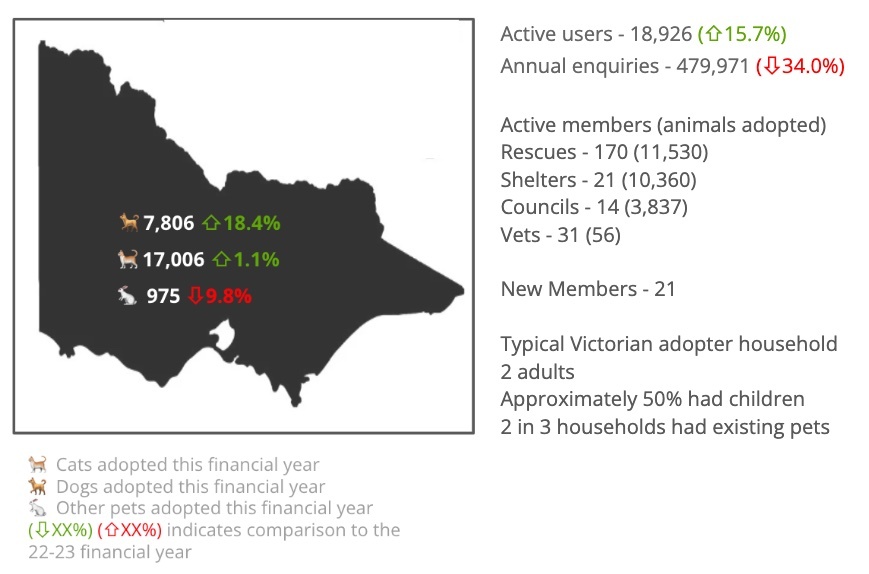
Victorian PetRescue members have consistently adopted out the highest number of pets for several years, and this trend continued in the 2023-24 financial year, with Victoria seeing a 5.4% increase in overall pet adoptions, with a total of 25,885 pets finding new homes. Victoria’s population of approximately 7 million people is smaller than NSW’s population (approximately 8.5 million people) and larger than Queensland’s population (5.6 million people), indicating that pet adoption is strongly embraced by the Victorian public.
92.1% of the 242 pet adoption organisations in Victoria are PetRescue members (excluding councils that do not rehome pets directly). Despite overall cat adoptions on the platform slightly decreasing during this time, Victorian members adopted out 17,050 cats this financial year, approximately 160 more cats than the previous financial year.
Rescue members in Victoria are performing incredibly strongly, rehoming more pets than all Shelter and Council members in NSW and Queensland combined, at 11,530 pets adopted into homes during the 2023-24 financial year. Victorian rescue groups adopted out 44.5% of pets who found homes via PetRescue in the state. Similarly, Victorian shelter members had strong adoption numbers compared to their counterparts from other states, rehoming almost as many pets as shelter members in the next three highest-performing states combined (NSW, Queensland, and WA). Shelters in Victoria adopted out 40% of pets in the state who found homes in the 2023-24 financial year. While council members in Victoria are by far out-performing councils in other states, finding new families for 3,837 pets, this still only represents approximately 15% of annual adoptions in Victoria.
Victorian households that adopted pets during this financial year were slightly less likely than the national average to have children in the home. Two-thirds of households had an existing pet, which is representative of the Australian pet-owning population. Victorian dog adoptions saw a large jump in the 2023-24 financial year, with an increase of over 18% on the previous year.
New South Wales

New South Wales has both the greatest number of members and the highest representation of adoption organisations on the PetRescue platform, with 96.5% of 345 organisations in NSW represented on PetRescue. PetRescue members based in New South Wales adopted out 14,287 pets, slightly over half of the number of pets placed by Victorian members, despite having approximately 100 additional member organisations in the state. Rescue groups adopted out approximately 61% of pets who found homes in the state, while shelters placed 20% of pets adopted in NSW over the same time.
Aside from Victoria, NSW was the only other state in which councils adopted out pets directly into homes, with 2,203 pets finding their families through councils. This number is increasing over time, and we hope to see continued growth into the future. While vet clinics in NSW adopt out a small number of pets relative to the other organisation cohorts, NSW members together place more than nine times the number of pets into homes than vet clinic members in any other state.
Anecdotally, the New South Wales rescue sector is reporting challenges to capacity more than other states, and Victorian rescues in particular are continuing to report a flow of pets for adoption from New South Wales into Victorian rescues. New South Wales does not have the highest median or average time to adoption for any species of pet, indicating that pets available for adoption are moving through the system at neither the fastest nor slowest rate compared to other states.
New South Wales is the most populous state in Australia, with over 8.6 million residents. The average household adopting a pet through the PetRescue platform in NSW during the 2023-24 financial year was very similar to the average adopter in Victoria, with two adults, approximately 50% of homes having kids, and two-thirds of homes having existing pets. Given the similarities between the Victorian and NSW human populations and living conditions, the comparatively large number of adoption organisations in NSW compared to other states, and the good representation of adoption organisations in this data set, it is unclear why NSW members are reporting more capacity issues compared to other states.
This could be due to low adoption demand in NSW causing extended lengths of stay compared to other states, despite similar pet ownership rates. If this is the case, it likely indicates that rescue pets are perhaps not considered as desirable in NSW relative to Victoria and other states. This could represent an opportunity for NSW member organisations to elevate the reputation of rescue pets in their communities and drive up adoption demand through improved marketing and adoption practices.
Queensland

Despite the temporary drop in adoptions in Queensland during early 2023, member organisations still found homes for a comparable number of pets to the previous year, with 13,876 pet adoptions in the state during the 2023-24 financial year. Relative to the overall population size, pet adoption demand in Queensland sits between Victoria and NSW, despite Queensland having a population density approximately one-tenth of Victoria and one-fifth of NSW. Cat adoptions in Queensland dropped by 13% compared to the previous financial year and appear to have been the main driver of the slight reduction in cat adoptions for the year seen at the national level. Dog adoptions increased by almost 10%, driven largely by puppies, with Queensland experiencing the largest number of puppies adopted of all states.
Pet adoptions in Queensland were primarily split between rescue groups (51%) and shelters (46%), with Vet Clinics adopting out a small but notable percentage of pets. While Queensland has six council facility members, none of these adopted out any pets via PetRescue during the 2023-2024 financial year. Of the states with the greatest number of adoptions via PetRescue, Queensland had the smallest growth of adopter profiles at just 2%, compared to NSW (increased by 9.6%) and Victoria (increased by 15.7%)
Additionally, 89.3% of 178 pet adoption organisations identified in Queensland are members of PetRescue and represented in this data, indicating that the total adoptions of rescue pets in the state are higher than reported here. Similar to Victoria and NSW, Queensland adopters were generally two adult households, 50% of which had children, and two in three homes had existing pets.
Generally, despite notable challenges for Queensland members and the pets they are caring for, related to extreme weather events and the dispersed nature of pet adoption organisations within the state, members are consistently creating positive, life-saving outcomes for Queensland’s pets.
Western Australia

Members in Western Australia together adopted out 6,452 pets in the 2023-2024 financial year. Rescue groups placed just over 55% of WA’s adopted pets into homes, while Shelters adopted out 45% of pets. Neither Councils (0 pets) nor Vet Clinics (9 pets) in WA facilitated an appreciable number of pet adoptions. Of the 139 councils in WA, only two are PetRescue members, indicating an unfulfilled opportunity for Councils to adopt pets directly into homes in WA.
PetRescue members make up 75.6% of the 78 adoption organisations identified in Western Australia, however, non-members include several large not-for-profit shelters in the Greater Perth area that advertise on their open websites. This likely indicates that PetRescue’s adoptions are an underestimate of the total pet adoption market in WA. That said, Western Australia’s population is slightly over half of that of Queensland, and its population density is less than half of Queensland's, so fewer adopters are more widely spread across the state. Despite these challenges, Western Australia’s PetRescue members placed a little under half of the number of pets for adoption than Queensland members, indicating that rescue groups in WA are performing a significant proportion of, if not the majority of, pet adoptions.
All species of pets saw an increase in adoptions between 3 and 10% compared to the previous year. Dogs saw the strongest growth in adoptions in WA, up by 10.6%, despite WA also having the highest average age for dogs of all the states. This potentially indicates an adoption market for dogs and especially puppies in the Perth region that could be filled by transporting rescue pets from other areas of WA or even other states.
South Australia

South Australian PetRescue members adopted 1,337 pets into new homes during the 2023-24 financial year, of which 98% were placed into homes by rescue group members. A standout feature of the sector in South Australia is the split between the main cohort of organisations working within the sector.
PetRescue members are primarily rescue groups and represent 67.3% of the 55 adoption organisations identified in South Australia. The remaining adoption organisations in South Australia include several large shelters that advertise on their own websites, one of which is a PetRescue member but does not actively advertise their pets on the platform. Councils in South Australia almost universally do not rehome pets directly, instead relying on large Shelters in built-up areas, or rescue groups in rural areas, to provide live outcome pathways for pets.
Adopters in South Australia were slightly less likely to have children in the home and slightly more likely to have pets (three out of four adopters) than the national average and larger states. Similarly to WA, South Australia experienced a decrease in both enquiries and platform users (potential adopters) in 2023-24 compared to the previous 12 months. However, total adoptions for all species increased by at least 4% during the same period, with cat adoptions increasing by almost 13%.
A.C.T.

PetRescue members from the ACT adopted 1,294 pets into homes this financial year, with adoption numbers for all species categories of pets increasing compared to the previous financial year. Dogs by far experienced the greatest increase in adoption numbers, with 104 more adoptions, equating to a 44% increase.
The majority of pet adoptions in the ACT were performed by the RSPCA ACT branch, with rescue group members adopting just under 9% of pets who found homes in the ACT during the year. The geography of the ACT likely has an impact on pet adoption patterns, as although the population of the ACT, at just under 500,000 residents, is only approximately 100,000 less than Tasmania, the land size is 29 times smaller. The ACT is by far the most densely populated state or territory in Australia, likely meaning that all residents are within driving distance of the RSPCA ACT shelter, or one of the two large council-run shelters.
Neither of the council-run animal shelters are PetRescue members, however the RSPCA and six other active members from the ACT are adopting almost as many pets as all members in South Australia combined. Adopters from the ACT are slightly less likely to have children or pets than the national average, and the larger states.
Tasmania

The five Tasmanian PetRescue members adopted 1,122 pets into homes during the 2023-24 financial year. This number comprised more than 1,000 cats, 27 dogs and 25 pets of other species. The majority of Tasmanian pets were placed through two large shelter members, Just Cats Inc and RSPCA Davenport.
Tasmania has at least four medium to large not-for-profit shelters that do not use the PetRescue platform, meaning that it is likely that pet adoption numbers on PetRescue largely underestimate pet adoptions in Tasmania. If this is the case, adoption demand in Tasmania is strong relative to the population. On average, only 1 in 5 adopting households in Tasmania have children, but 3 out of 4 have existing pets.
Northern Territory

The three active members in the Northern Territory together adopted 436 dogs and cats into new homes during the 2023-24 financial year. These adoptions were primarily through two members located in Darwin, one shelter, PAWS Darwin (68% of pets) and one rescue group, A Safe Place For Meow (29% of pets). The single council member from the Northern Territory, Barkly Regional Council, found homes for 16 dogs during the financial year.
Overall, adoptions dropped for both dogs and cats compared to the previous financial year, by at least 15%, and no other species of pets were adopted into homes in the NT. Adopters in the Northern Territory were the most likely to have an existing pet, with more than four out of every five homes having pets already, and two in three having children in the home. The number of potential adopters in the Northern Territory increased by almost 12%, despite a significant drop in enquiries by over 50%.
Jump to specific insights from the report:
|
1. |
12 mins |
|
|
2. |
Pet Adoption Trends & Insights |
15 mins |
|
3. |
23 mins |
|
|
4. |
19 mins |
|
|
5. |
19 mins |
|
|
6. |
19 mins |